The Strange Economics of Free Food
Put a tray of donuts on a conference table and charge a dollar apiece, and half the room does quiet mental math and walks away.
Make them free, and everyone eats one. Someone eats three, and I’ll be honest, that someone is often me. The colleague who announced two weeks ago that she was cutting sugar is unwrapping her second before the meeting starts.
Nobody planned this. Nobody consciously decided to abandon their better judgment at 9:15 in the morning. The donuts did not change. The price did, and that turned out to be enough.
The Word That Breaks Brains
Behavioral economists call this the zero-price effect, and it is more useful than it sounds. Somewhere between “a dollar” and “nothing,” a switch flips. We stop asking whether we actually want the thing and simply take it.
Researchers Kristina Shampanier, Nina Mazar, and Dan Ariely studied this in 2007 and found that lowering a small price to zero can produce a disproportionately large increase in demand. Free is not merely a discount. It becomes a different category of decision-making, one that relies less on arithmetic and more on instinct.
Free food at a conference is the Wild West, just with a tablecloth.
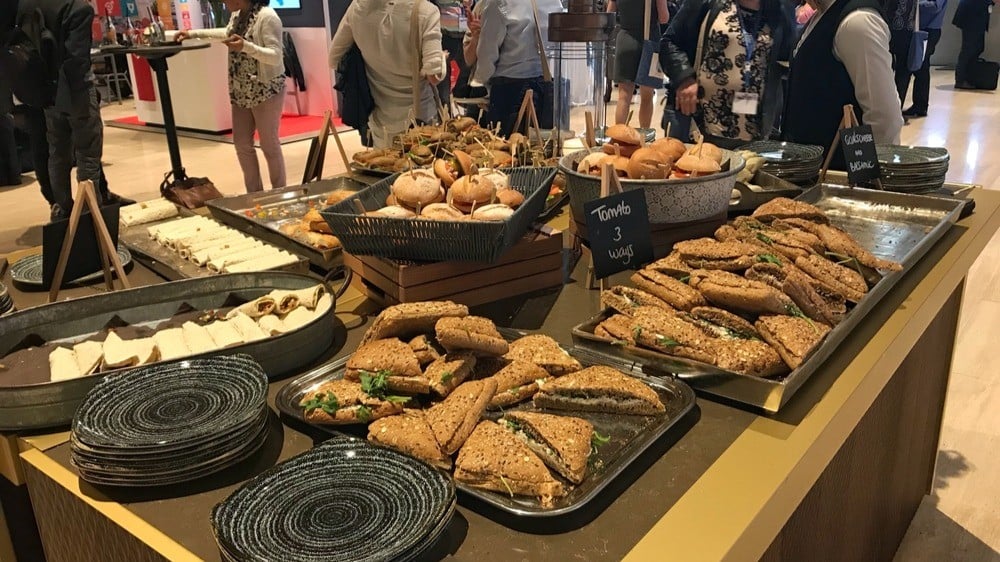
What makes “free” so disarming is that it does not only make things cheaper. It makes them feel better. That wrapped triangular sandwich, the one that would sit forgotten in a deli case all afternoon, suddenly becomes worth grabbing the second it costs nothing. The sandwich has not improved. The math around it has simply stopped applying.
What Actually Happens in the Wild
Watch a room full of professionals encounter a free spread and you will see the same choreography every time. A sandwich that could sit untouched for hours in a break room refrigerator disappears in ten minutes once it lands on a folding table beneath a handwritten “FREE” sign.
People drift toward the platter while maintaining perfect eye contact with whoever they are talking to, as though their feet have started operating under a separate contract from their brain. In a very real sense, they have.
Dietary convictions, the ones people will defend passionately at dinner, go strangely quiet the moment food costs nothing. That is not necessarily weakness or hypocrisy. Zero dollars unlocks something that $1.50 does not. The food has not changed. The price is simply powerful enough to alter the decision.
My favorite is what I have started calling the “for later” phenomenon. Someone is mid-bite on a cookie, reaches back without breaking conversation, and grabs a second one.
“I’ll save this for later,” they say, with complete sincerity.
That cookie will be gone before they reach their desk. Everyone knows it, including the person holding it. The fiction survives anyway because it sounds more reasonable than the truth: something considerably older than professional decorum has taken the wheel.
Give it five more minutes and the plates start reflecting ambition more than appetite. Items nobody actually wants show up anyway because leaving value on the table, even the kind measured in stale pita chips, registers as a loss.
Why We Are Wired This Way
Some of this traces back much further than any conference room. For most of human history, food was not guaranteed, and passing up available calories was a poor strategy that had nothing to do with willpower.
That instinct does not know or care that a full lunch is waiting in your office refrigerator. When food appears and costs nothing, something older than your judgment quietly says eat, and it says it before your judgment gets a vote.
Loss aversion does some of the remaining work. Daniel Kahneman and Amos Tversky’s research showed that losses tend to feel more significant than comparable gains. Walk past a free food table and take nothing, and it can feel faintly like giving something up, even when you were not hungry and even when the available option is egg salad.
Then there is the social layer, which may be my favorite part of the entire spectacle. Nobody wants to be first to lunge at the tray because that looks aggressive. But the instant the group begins moving, the group moves.
I have personally watched composed, credentialed professionals execute an impressive footrace toward a sandwich platter while doing their best to look as though nothing unusual was happening. We are social creatures running competitive economics while holding paper plates, and somehow we have all agreed not to mention it.
What This Means for Leaders
Here is where the observation becomes useful. Free food is one of the most underrated tools a leader has, and many of us treat it as an afterthought.
A catered lunch tells people something a memo never will: someone thought they were worth feeding. That carries more weight than it sounds like it should. I have sat through mandatory training content that was survivable largely because a sheet cake and a vegetable tray were waiting at the back of the room.
Feeding people changes how they behave with one another, not just what they eat. They linger. They talk after the agenda ends. Departments that rarely cross paths end up standing in the same corner, and for a few minutes the organizational chart becomes less important.
A decent spread can do more for informal connection than many core-values exercises, and usually at a fraction of the cost.
But generosity has a shelf life, and this is the part leaders often miss. The first surprise pizza lunch is a gift. The tenth one, arriving every other Friday, is an expectation with pepperoni on it.
Once free food becomes routine, it stops registering as generosity and starts registering as baseline. An unannounced ice cream afternoon in July can spark genuine delight. “Donut Friday,” three years running, sparks nothing at all. It is simply Friday now.
There is also the danger of implied food. An early meeting billed with breakfast carries a promise. A “working lunch” makes the promise explicit. A networking reception suggests something more substantial than warm sparkling water and a bowl of mints.
When the food fails to appear, people will smile through it in the room. They will absolutely review the decision in the parking lot afterward, often in more detail than the meeting itself deserved.
The Bottom Line
Free food works like a mirror, and not always a flattering one. It shows the gap between the version of ourselves we believe we are, disciplined and intentional, and the version that appears once the price reaches zero.
That version takes the cookie. Takes a second one. Wraps a third in a napkin for the walk back to the desk, already rehearsing the “for later” explanation before anyone asks.
None of this makes us weak or undisciplined. It makes us human, running on wiring that predates spreadsheets and quarterly planning by a considerable margin.
Understanding the machinery does not make the pull disappear. It simply allows us to watch our own hand reach for the cookie with slightly more amusement and considerably less surprise.
References: Shampanier, K., Mazar, N., & Ariely, D. (2007). Zero as a special price: The true value of free products. Marketing Science, 26(6), 742–757. Kahneman, D., & Tversky, A. (1979). Prospect theory: An analysis of decision under risk. Econometrica, 47(2), 263–292.
Thanks for reading!
Subscribe to receive my weekly newsletter, alerts when new posts are available, and occasional updates from me.
Thank you for subscribing!
Have a great day!