The Pink Slip That Pushed Me Into Ownership
The day I got fired, I thought I was about to become a practice owner.
For seven years I'd worked as an associate at that clinic, and buying the place felt like the obvious next chapter. I knew the clients. I understood the books. I had already started picturing my name on the building. So when the owner finally named his price, I expected a negotiation. What I got instead was a number so far past reasonable it might as well have come with a lottery ticket and a couple of wealthy in-laws attached.
I said no. He didn't counter.
He fired me.
There were, as I saw it, two ways forward from there. One was familiar: dust off the resume, find another associate job, and go back to contributing to somebody else's vision. Safe, respectable, and about as exciting as a Tuesday. The other path didn't come with a map. It came with a question mark, a truck full of farm equipment, and — though I didn't know it yet — a building that used to be a tanning salon.
The truck came first.
For a couple of years before any of this, I'd been running a mobile large-animal practice on the side. In the early days, "running" is generous. It was a well-used truck, a tangle of supplies tossed in the back, and a system that mostly consisted of hoping nothing important had rolled under the seat by the time I got to the farm. Eventually it grew into something more legitimate — a real veterinary truck, custom box, refrigeration, an x-ray unit, a place for everything. But what that side practice actually gave me wasn't the equipment upgrade. It was a taste of running my own show. I liked making the calls. I liked knowing that if I worked hard and treated people right, the results came back to me directly. That truck planted a seed that I couldn't un-plant: ownership wasn't just appealing. It was possible. I'd already been doing a small version of it without quite admitting that's what it was.
Then I found the building.
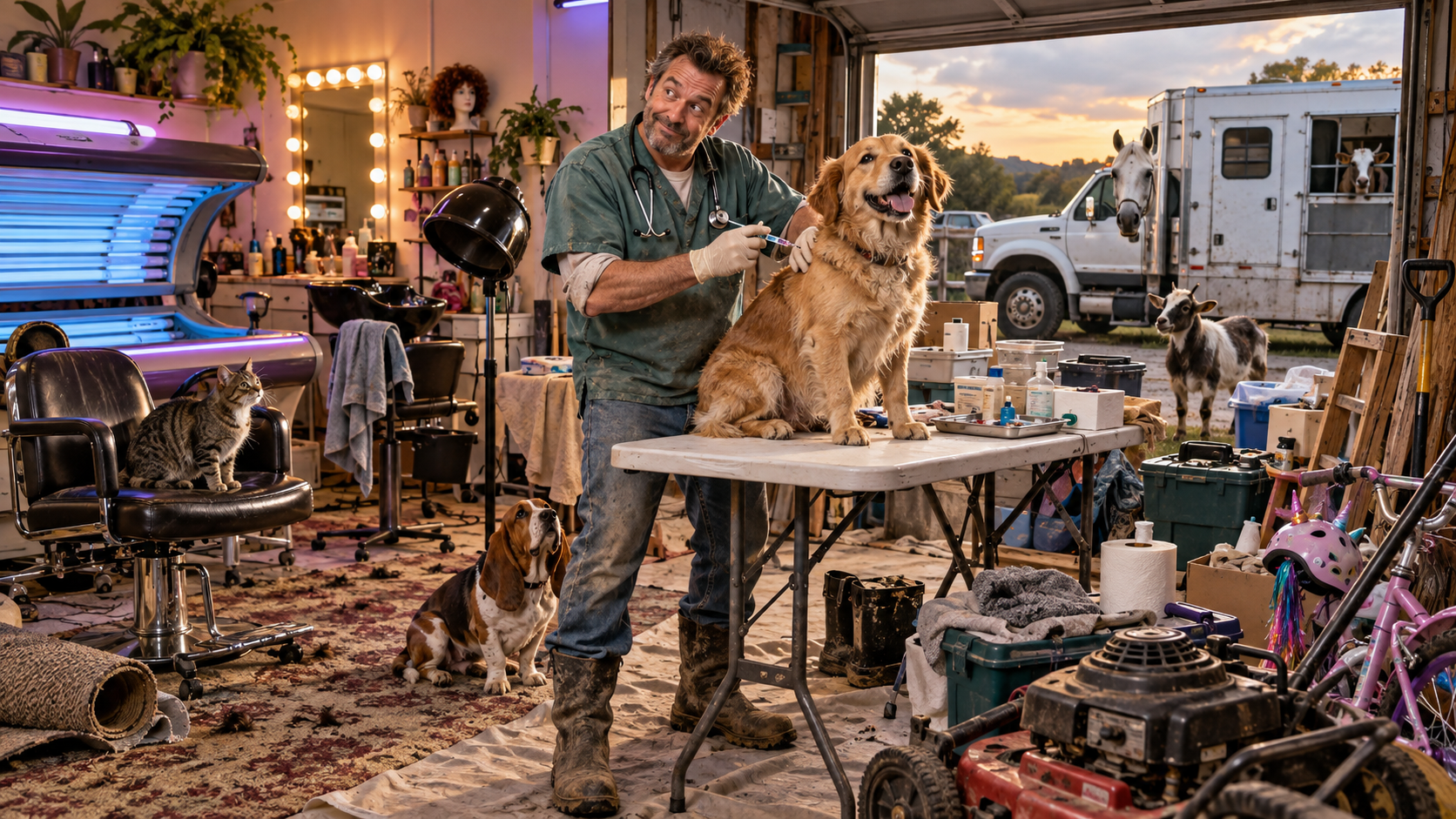
It had been a tanning salon and hair studio in its previous life, and it had not let go of that identity gracefully. Bad lighting, carpet that had clearly seen things, and the lingering feel of a place where a lot of people had made regrettable decisions about their bangs under fluorescent bulbs. It did not look like a veterinary clinic. It looked like drywall, concrete, and the ghosts of perms past.
The timing was about as bad as it gets. I'd just lost my income. I had two young kids at home. The building needed real work, and I had no cushion of confidence to fall back on — just a pink slip and an idea. This wasn't a tidy, well-lit transition from associate to owner. It was a forced pivot with bills attached.
So I did the only thing that made sense to a guy raised to distrust feelings he couldn't put a number on: I sat down and worked the math.
Seven years as an associate had let me build a modest emergency reserve. The mobile practice was bringing in steady income on its own. My wife, a registered nurse, had a stable job and a paycheck that didn't depend on my decisions at all. When I laid all of that out on paper, the fear didn't vanish — but it changed shape. It stopped being a shapeless thing growling in the corner and became a list of numbers I could actually look at. My worst case wasn't ruin. It wasn't losing the house. It was burning through some savings, learning an expensive lesson, and going back to being somebody's associate. That's not a fun outcome. It's also not a catastrophe. Once I could see that clearly, the decision got a lot easier to make.
Before the clinic was anywhere close to ready, I was seeing clients out of my garage. People drove up, and I examined their pets on a folding card table wedged between the lawnmower and my kids' bikes. There was nothing about it that belonged in a brochure about entrepreneurship. But it moved. I could paint a wall one evening and see a patient the next morning, and that was enough to keep going. I didn't have a finished plan or a finished building or a finished version of myself as a business owner. I had a folding table and a next step, and it turned out that was plenty.
Eventually the doors opened for real. And the moment that made it feel real wasn't dramatic at all.
My first official client at Brown Veterinary Service came in for a rabies vaccine. Nothing more complicated than that — no emergency, no big case, no swelling music. I wrote it in the paper schedule, examined the dog, and printed a receipt with "Brown Veterinary Service" across the top. Financially, it amounted to almost nothing. Psychologically, it was everything. Somebody had chosen to bring their pet to my clinic, under my name, and pay for it. The someday idea I'd been carrying around for years had just become a Tuesday afternoon.
I've had bigger months since — better cases, bigger numbers, real milestones. But none of them have quite matched that rabies vaccine, because none of them had to prove the basic thing: that this could actually work. The big milestones confirm that something is going well. The small first ones confirm that it's real at all. That's a different kind of proof, and it's worth more than its size suggests.
Looking back, I think the garage and the truck were doing the same job, just at different scales. They were both small versions of the thing I eventually wanted, built before I was ready to commit to the full-size version. That's probably the most useful pattern in the whole story, and it applies well beyond veterinary medicine. Freelance before you quit the job. Consult before you start the firm. Run the workshop before you launch the program. Sell the first one before you lease the warehouse. You don't need the finished version to start — you need a version small enough to survive a bad outcome but real enough to teach you something true.
Getting fired was never part of the plan. At the time, it felt like the floor giving out — like getting pushed off a dock before I was sure I could swim. But it forced a decision I might have put off for years, and it turned ownership from a someday idea into a Tuesday-morning choice.
The business itself didn't last forever in that form. But the way I think about risk, about decisions, about leading people through uncertainty — all of that traces back to a folding table in a garage and a single rabies vaccine. The real lesson was never about owning a clinic. It was about finding out I could bet on myself and actually follow through.
And once you know that about yourself, it changes how you walk into every room after.

Thanks for reading!
If this made you think about risk, reinvention, and what can happen when the plan falls apart, you’ll probably like Mostly Housebroken.
Thank you for subscribing!
Have a great day!