The $100,000 Mobile Vet Clinic
A Class in Expensive Business Lessons
In 2013, I bought a used mobile veterinary clinic for about $100,000, which is the kind of sentence that can sound either visionary or ridiculous depending on how the story ends. At the time, I was fairly certain it was visionary.
Brown Veterinary Service was doing well. Our small animal clinic was profitable, the large animal mobile practice was busy, and I had a strong team helping manage the daily grind. At the same time, I was running a successful e-commerce business, which meant my days were split between veterinary medicine, operations, product sourcing, customer service, and whatever fresh problem had wandered in wearing muddy boots. It was a busy season, but it was working.
In hindsight, that was part of the problem. Success has a way of making the next idea feel safer than it really is. When enough things have gone right, you start to believe your instincts are a business plan, and risk begins to feel familiar, almost manageable — as if you have already proven you can handle whatever shows up next.
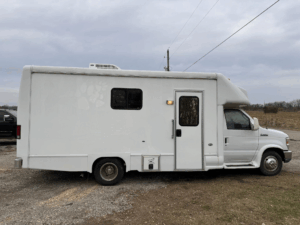
That is when I found the mobile clinic — a used Laboit unit, fully outfitted and ready to roll. This was not a pickup truck with a thermometer and a folding table in the back. It was a legitimate veterinary clinic on wheels, with space and equipment for exams, spays, neuters, dentals, and X-rays. It looked like access. It looked like growth. It looked like leverage.
In my head, the business model assembled itself quickly. We could park at Tractor Supply stores, Walmart lots, farm stores, rural communities, and underserved areas across West Virginia, providing convenient care, reaching new clients, expanding services, generating revenue, and building something that felt both innovative and useful. It seemed obvious — which I have since learned is often when an idea deserves more scrutiny, not less. I had not learned that yet.
The Truck Was Not the Business
The first mistake I made was believing the purchase price represented the cost of the idea. The truck was about $100,000 — a serious number, but one that felt understandable. I had owned businesses long enough to know that payroll, insurance, equipment, supplies, fuel, and maintenance all mattered. I was not new to expenses, and I certainly was not new to the feeling of taking a calculated risk.
But I misunderstood what I was actually buying. I was not buying a piece of equipment — I was buying the obligation to build an entire operation around that equipment. The truck was simply the most visible part of a much larger and more demanding system.
To run it properly, I would have needed another veterinarian, additional support staff, mobile surgical protocols, specialized insurance, scheduling systems, inventory management, equipment maintenance, controlled substance procedures, waste disposal logistics, radiology compliance, marketing, fuel, repairs, and contingency plans for the inevitable moment when something failed on the road.
That is the part entrepreneurship tends to hide. The exciting piece is the asset. The expensive piece is everything required to make that asset function safely, consistently, and profitably. A mobile clinic sounds like one idea, but in reality it is a bundle of interdependent systems moving down the highway together, each capable of creating problems at exactly the wrong time. The truck cost $100,000, but the business required far more than the purchase price.
Revenue Looks Good on Paper. Cash Flow Shows Up in Real Life.
Once I had the idea, the numbers started to cooperate. This is where experienced operators can still get themselves into trouble. You take a reasonable concept, layer in a few optimistic assumptions, multiply by a full schedule, and suddenly the spreadsheet begins to look reassuring — a certain number of procedures per day, at a reasonable fee, across a consistent calendar. The math adds up quickly when every variable behaves itself.
On paper, it worked. But I was solving for revenue, not cash flow. Revenue is theoretical until it arrives, and expenses are not. Payroll shows up on schedule. Insurance premiums do not wait for momentum. Fuel, supplies, maintenance, inventory, and staffing costs begin immediately, long before a new service becomes predictable.
That gap, between when money goes out and when it reliably comes in, is where pressure builds. The mobile clinic might have produced revenue over time, but the financial obligations would have started on day one, adding strain to a system that was already fully engaged. Profit tells you whether a model works eventually. Cash flow determines whether you survive long enough to find out.
I Mistook Capacity for Momentum
At the time, I was managing a small animal clinic, a mobile large animal practice, and an e-commerce business. We had good people, the systems were working, and from the outside it looked like there was room for one more initiative. There was not.
A business can be healthy and still require leadership. A capable team still needs clarity, and stable systems still need attention — just because something is not on fire does not mean it no longer needs oxygen. I told myself the mobile clinic would be one more service line. In reality, it would have introduced an entirely new layer of complexity: new workflows, new staffing demands, new compliance issues, new scheduling challenges, new client expectations, and new ways for an ordinary day to become unnecessarily complicated.
Entrepreneurs often underestimate this part because we tend to focus on whether an idea is possible. Could this work? Would people want it? Could we make money? Could we build it? Those are reasonable questions, but they are not enough. The better question is whether the business has the leadership bandwidth to absorb the opportunity without weakening everything else.
That was the question I had not asked closely enough. My calendar was already full. My attention was already divided. My existing businesses still required judgment, direction, and presence. The mobile clinic did not need casual enthusiasm — it needed focused leadership, and I did not have enough of that available.
When Experience Becomes a Liability
One of the harder truths in this story is that I did not make the decision because I lacked experience. I made it, in part, because I had experience. That is what made it dangerous.
By then, I had built businesses that worked. I had made decisions that paid off. I had taken risks that turned out well. Each success added a little more confidence, and confidence is useful — leaders need it, entrepreneurs need it, and nobody builds anything meaningful by staring at every opportunity until it dies from neglect. But confidence needs a counterweight, and without one, it can quietly replace discipline.
I began skipping steps I knew better than to skip. I did not model the downside rigorously enough. I did not validate the market deeply enough. I did not fully map the staffing requirements, operational demands, or financial pressure. I did not spend enough time asking what the business would look like if it worked slowly, unevenly, or at a higher cost than expected.
The unglamorous work would have helped. It usually does. Financial modeling, market testing, operational planning, worst-case scenarios, and pressure-checking assumptions rarely feel exciting, but they have saved more businesses than enthusiasm ever has. Instead, I liked the idea so much that I treated my enthusiasm as evidence. It was not a plan. It was a daydream with tires.
The Market Needed It. I Had Not Proven It.
The idea itself was not foolish. Rural communities do need better access to veterinary care, convenience matters, and many pet owners would appreciate services brought closer to them. There was real potential in the concept. But potential is not validation.
I assumed clients would want mobile surgical services because I could explain why they should want them. That is a subtle but important mistake. Entrepreneurs are often very good at explaining why an idea makes sense — we can describe the problem, the solution, the opportunity, the need, and the upside, and make it all sound so reasonable that disagreement feels almost impolite.
The market does not care how reasonable the idea sounds. The market only cares whether enough people will actually buy the service at the required price, in the offered setting, on the available schedule, with enough trust to make the model sustainable. I had not tested those pieces carefully enough. I had not piloted the concept. I had not confirmed volume. I had not fully studied how clients would feel about surgery in a mobile setting versus a traditional clinic. I had not done enough to separate a useful idea from a viable business. The distance between a good idea and a viable business is usually longer than it looks from the driver's seat.
The Tuesday Afternoon Reality
The clean version of the mobile clinic was compelling: drive to a community, park in a visible location, provide needed care, serve clients, generate revenue, expand access, and repeat. The real version was less tidy.
Where exactly would we park, and with whose permission? What would happen in bad weather? How would we manage patient recovery safely? What if the generator failed? What if the X-ray system had an issue? What if a surgery ran long and the next client was waiting outside? What if someone did not show up? What if controlled substances needed to be secured while the vehicle was away from the clinic? What if the truck needed repairs during a fully booked week?
Those are not small details. Those are the business. Every business has a Tuesday afternoon version — the one where people are tired, the schedule is tight, something is running behind, a piece of equipment is not behaving, and the elegant plan is now rubbing against reality. That version matters more than the polished version because that is the one your team and your clients actually experience. Operational reality always gets a vote, and if you ignore it early, it will introduce itself later with a bill.
The Decision That Actually Mattered
Within about 30 days, the picture was clear. The mobile clinic was not a small adjustment — it was a fundamental mismatch. And the harder decision was not buying it. The harder decision was choosing what to do after I realized I had misjudged it.
I could continue investing time, money, and energy trying to force the model to work, or I could accept the mistake and exit early. The first option would have protected my pride for a little while. The second option protected the business. So I sold it, at a loss.
It was not painless, but it was right. The money I had spent was already gone, and keeping the clinic would not have improved the original decision — it would only have made the lesson more expensive. There is a difference between persistence and stubbornness: one builds businesses, the other funds them unnecessarily. Cutting the loss was not failure. Done early enough, it was leadership.
Not Every Opportunity Is Yours to Build
Looking back, the most important lesson was not really about mobile clinics. It was about fit. An opportunity can be valid, useful, and promising and still not be right for you at that moment, in that context. That is hard for entrepreneurs because we are wired to see possibility — we like building, solving, improving, expanding, and taking the thing that does not exist yet and dragging it into reality.
That instinct can create wonderful things. It can also create expensive distractions. The better question is not always, "Could this work?" Many things could work. The better question is, "Should I be the person to make this work right now?"
That question forces a different kind of honesty. It makes you look at your current responsibilities, your team, your cash flow, your leadership bandwidth, your family, your energy, your priorities, and the opportunity cost of saying yes. Every yes costs something — sometimes money, sometimes focus, sometimes peace, sometimes attention pulled away from something that was already working and deserved more care. The mobile clinic had potential, but potential is not the same as priority.
The Lesson That Stayed
That $100,000 mobile clinic became one of the most valuable business lessons I ever paid for. It taught me to slow down when something feels obvious, to separate enthusiasm from evidence, and to evaluate total cost, not just purchase price. It taught me to respect cash flow, validate demand, study operational reality, and guard leadership attention as carefully as capital. Most of all, it taught me the value of changing direction early.
There is a version of pride that tells you to keep going so you can prove you were right. There is a better version that allows you to stop when continuing no longer makes sense, and I would rather absorb a painful lesson early than spend years financing my own stubbornness. Every entrepreneur collects a story like this over time — a second location, a product line, a new hire, a partnership, a software platform, a building, or a service that looked wonderful on paper and revealed itself to be something else entirely once it met real life.
Mine just happened to come with wheels.
And a six-figure lesson attached.

Thanks for reading!
If you’ve ever had to decide whether to keep pushing or admit something no longer makes sense, you’ll probably like Mostly Housebroken.
Thank you for subscribing!
Have a great day!