In a World of Avatars, Talking Becomes a Superpower
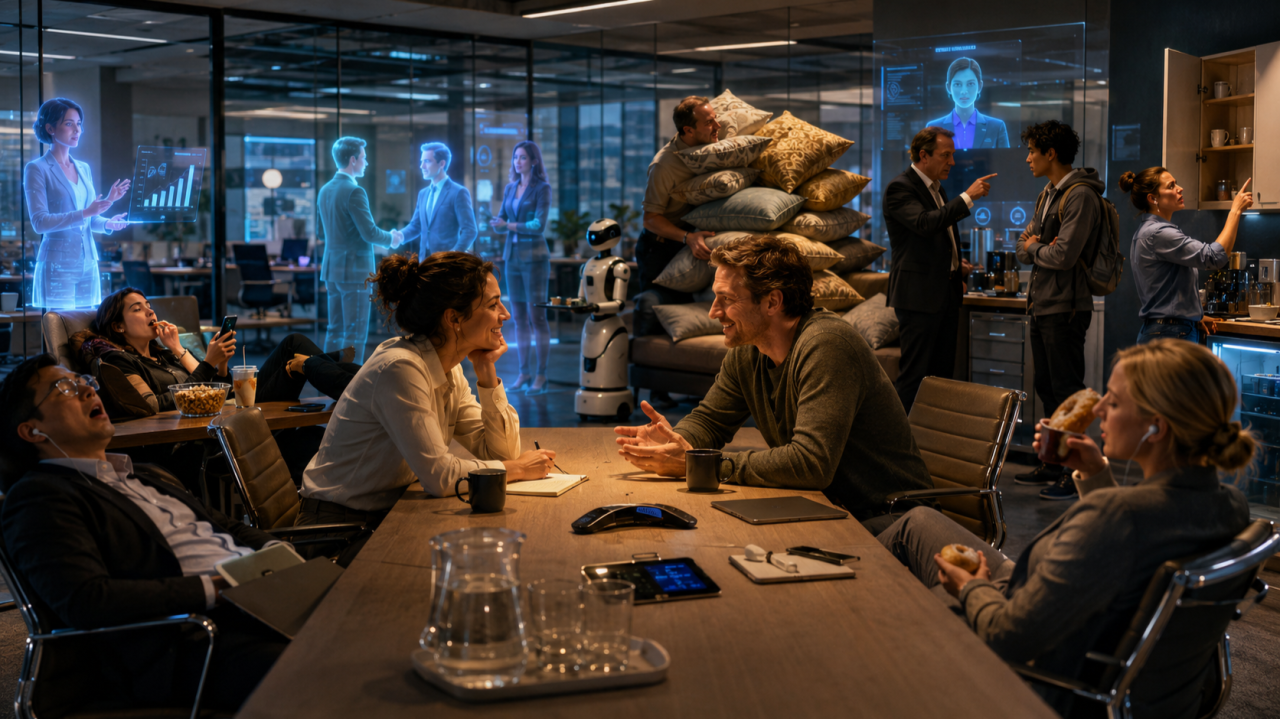
I have always loved those Progressive commercials with Dr. Rick, the "Parenta-Life Coach" assigned to young homeowners who are slowly, helplessly becoming their parents. He catches them in the wild: giving strangers unsolicited advice at the gas pump, policing the item count in the express lane, or arranging so many decorative pillows on a couch that there is no longer room for a human being. I used to watch those ads as an amused outsider. Then, somewhere along the way, I realized I was no longer observing the patients. I was one of them.
I've said actual dad-group sentences out loud, in an actual grocery store, to actual adult children who did not request my opinion. I now hold strong, unsolicited views on pillow-to-seating-space ratio. And I'm not remotely alone. People my age, and plenty younger, watch these ads and see their own diagnosis in nearly every session Dr. Rick runs. There's something comforting in that. We didn't turn into our parents alone. We did it together, on schedule, and an insurance company built a whole ad campaign around staging the intervention before most of us noticed the symptoms ourselves.
I bring this up because those ads work for the same reason a much older, much less funny observation keeps making the rounds: people don't talk to each other the way they used to. It's an adage at this point, worn enough to sound like a complaint from a guy who just realized he owns too many throw pillows. I want to say it without the complaint attached, because I think it's true, and I think something genuinely interesting is coming because of it.
Think about the last real disagreement you tried to work out over text. Misunderstandings multiply in writing. They don't shrink. A sentence with no tone attached gets read in whatever tone the reader already happens to be carrying that day, and it's rarely the generous one. A conversation that would take four minutes face to face turns into a forty-five-minute back-and-forth, where a period feels like a slammed door and a one-word reply feels like a declaration of war. Now stretch that same pattern across another decade or two of faster tools and easier ways to avoid a hard conversation entirely, and it's not hard to picture a future where the average person has genuinely lost the reps. Where "just talk to them" stops being obvious advice and starts being a skill only a few people have bothered to keep sharp.
Picture business fifteen years from now. Not flying cars — just a straight extension of where things are already headed. Your calendar's run by something that sounds enough like you to fool people who know you, handling routine correspondence competently, because that work was never really about you to begin with. Customer service finishes the journey it's already most of the way through: a problem shows up, and something diagnoses it, resolves it, and apologizes in a tone calibrated to your stress level, no human required. Sales pitches assemble themselves in seconds, tailored to whoever's receiving them. Negotiations happen between two digital agents that never tire and never accidentally reveal more than they meant to.
It'll be extraordinarily efficient by most measures. And somewhere in the middle of it, I think a lot of people are going to feel something missing before they can name it.
Because there's a thing none of that can do. It can't sit across from a furious client and rebuild trust through nothing but presence and patience. It can't catch the half-second hesitation that means someone's about to walk from a deal for a reason they haven't said aloud. It can't tell a story around a table that makes a skeptical buyer lean in instead of just processing a pitch. It can't take a badly explained problem and understand, through nothing but attentive listening, what a person actually means underneath their own words. A digital agent can execute a plan flawlessly. It cannot improvise trust.
So I picture the businesses that figure this out first. In a world where every competitor's avatar sounds equally polished and equally forgettable, the person who sits down, looks a client in the eye, and talks to them like a human being instead of a transaction is going to hold an advantage that's hard to overstate. Not because the technology failed — because it succeeded at everything except the one thing it was never built to do.
Great communicators — the client-facing ones, the natural salespeople, the ones who can walk into a tense room and just handle it — are about to become some of the most valuable people any company has. Not a nice-to-have next to the technology. The actual differentiator, once the technology's the same for everybody. The person who's a natural at reading a room, who can defuse an angry client with tone and timing alone, who can earn a stranger's trust in ninety seconds, is sitting on a skill set that's about to be worth a great deal more than people currently assume, mostly because so few will have kept building it while everyone else managed their avatar's calendar.
Here's the good part. None of this requires inventing anything or catching a wave early. It's built the old way, with reps, same as it's always been. Every real conversation instead of a message. Every hard call made instead of let a template make it. Every pause allowed to sit instead of rushed to fill. That's training, and it's going to count for more than it currently does.
I'll still be chasing whatever's new by this afternoon, same as everybody else, because that's the world now. But I'm also going to keep sitting down across from people and actually talking to them, plainly and directly, the old-fashioned way. Fifteen years from now, when everybody else's business runs through a very polished avatar, I have a feeling that skill looks less like an old habit and more like the rarest advantage left in the room.
We'll keep laughing at Dr. Rick's support group, I imagine, the same way we always have — recognizing ourselves a little more each year, a little further down whatever road our parents were already on. There are worse fates. At least the people in those commercials are still in the room, still talking, still gently roasting each other about the pillows.
Enjoyed the essay?
Get Mostly Housebroken, my free Sunday newsletter about life, people, and the strange things we do. You'll also receive a free copy of my eBook, Soup Beans on the Good China.
You're in!
Thanks for subscribing. Your free eBook, Soup Beans on the Good China, is headed to your inbox. Look for Mostly Housebroken every Sunday.
Be sure to check your spam folder if you don't see the email.