Before You Had Money, You Had a Money Story
What's your relationship with money?
Not how much you've got. That's a different question, and a fairly boring one. I mean what happens in your chest when the topic comes up. Do you feel steady? Twitchy? Free? A little guilty for no reason you can name? Does your brain start doing math the second you see a price tag — what it costs, how long you'd need to replace it, and whether buying it might somehow end in you living out of the truck by Thursday?
Most of us figure we picked up those reactions as adults. We earned money, spent some, saved some, blew some on things we don't like to discuss, borrowed more than we meant to, and eventually landed on an opinion about the whole business.
I don't buy it.
I think most of us had a money story before we ever had much money. Somebody handed it to us before we were old enough to know we'd been handed anything, and definitely before we were sharp enough to ask for a receipt.
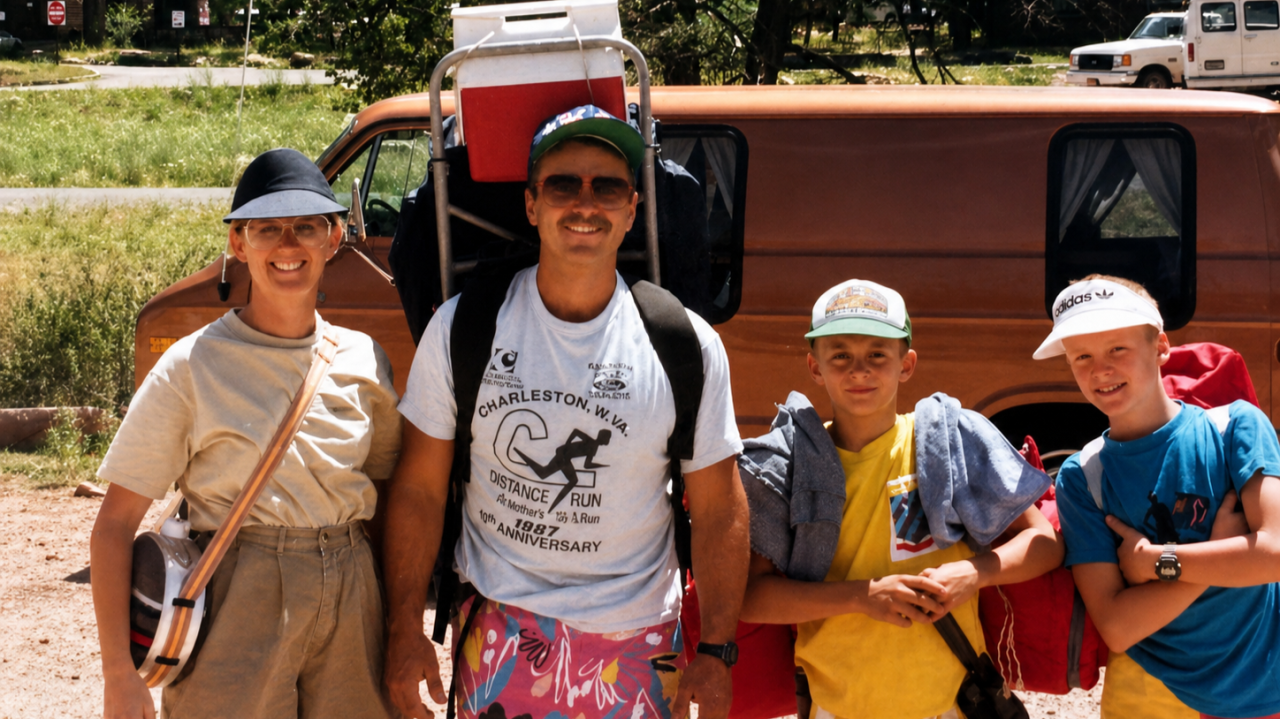
My parents were both middle school teachers. We weren't wealthy, but I never once felt like we didn't have enough. Ask ten-year-old me if we had enough money and I'd have looked at you like you'd asked if we had enough oxygen. Obviously. We had food, a house, clothes, and summer vacations planned with the precision of a small military campaign — coolers, paper sacks, maps, snacks, backup snacks, and enough gear packed in that truck to suggest my parents weren't entirely convinced other states had grocery stores.
What I didn't clock back then was how little they spent on themselves next to what they'd spend on my brother and me. I just assumed that was how families worked — that dads generally wore the same three shirts on rotation and moms didn't buy anything for no reason. Kids are excellent at noticing what they receive and stone blind to what it cost somebody else. You don't understand the trade until years later, standing in a store doing the same quiet math for your own kids, realizing the stuff that felt effortless growing up took somebody a lot of effort.
We didn't talk about money in our house. No budget meetings. Nobody broke out a legal pad after supper to walk us through compound interest. Retirement accounts, investment strategy, the financial wisdom of a bass boat — none of it came up.
Money wasn't the elephant in the room. It was more like the family dog under the table. Everybody knew it was there. Nobody saw much reason to point at it.
That silence followed me to school. I had a tight group of friends in high school, and money rarely came up there either. We had a rough sense of who had more and who had less — you could generally tell from the house, the driveway, or what somebody's folks did for a living. Some of my friends had a lot more than we did. Some had a lot less. Didn't seem to sort anybody out of the group.
We talked plenty about what we wanted to do with our lives. I don't remember many of us picking a path because of the paycheck attached to it. We talked about becoming teachers, vets, doctors, engineers, whatever had caught our interest that month. Making a living mattered, sure, but it wasn't the opening question. We asked "what do you want to do" a lot more than "which one pays best."
That's shifted. Kids today are tracking salaries, student debt, and housing costs before they've picked a major, and I don't fault them one bit — it's an expensive world, and picking a career without running the numbers first is a luxury a lot of people can't afford anymore. Still, it's a real change. We thought about the work first and the paycheck second. A lot of young people now have to think about both in the same breath.
Even without a single lecture, I picked up plenty. You fixed things before you replaced them. You waited for the sale. You kept something as long as it worked, even if it was ugly enough to make a toddler cry. You didn't spend money just because it happened to be sitting there.
My parents helped me through college and vet school, and I still walked out in 2001 carrying about eighty grand in student loans. That was real money then, and it would've been a lot more without their help. They never made a speech about the sacrifice. They just helped — the same quiet way they saved, patched things up, and lived well under their means without ever turning it into a lesson.
My grandmother lived with us too, and she'd made it through the Great Depression. People who live through something like that don't just remember it — they carry it, and pieces of it leak into the household whether anybody names it or not.
It showed up as "we might need that later." It showed up in saved containers, reused everything, and leftovers that stuck around a couple days past what the food safety folks would call responsible.
She never sat me down and explained scarcity. Didn't need to. I absorbed it anyway — don't waste a thing, save what you can, and assume whatever you've got today might not be there tomorrow.
None of that was bad advice — it's likely the whole reason my parents managed to retire in their fifties after long careers in a classroom. Two schoolteachers, living below their means, saving on a schedule, and building a retirement that now lets them travel and actually enjoy what they worked for. No lottery ticket. No surprise inheritance. No hot stock tip from a stranger at a gas pump. Just discipline, patience, and a whole lot of not buying things they didn't need.
There's real dignity in that. But I inherited the caution right along with the discipline, and those two don't always ride in the same truck.
Even now, after a solid career and a couple of businesses that did fine, there's a little voice in the back of my skull telling me to be careful. Doesn't matter that nothing's on fire. Some part of my brain is still keeping score like we might need to trade the truck for a horse and start bartering eggs any day now.
The voice is quieter than it used to be. It has never fully packed its bags, though.
Here's the funny part — after vet school, I got genuinely fascinated with personal finance. Subscribed to Kiplinger's. Read the investing books. Learned about mutual funds, retirement planning, asset allocation, tax strategy, and every other topic capable of turning a reasonable person into someone with strong feelings about expense ratios.
Felt like everybody else got handed a manual growing up, and I'd been handed a flashlight and a pat on the back. So, I built my own manual, one magazine and one library book at a time.
I learned how money works. What took a lot longer was figuring out that knowing how it works doesn't automatically change how it feels.
You can understand investing cold and still flinch at spending. You can have plenty and still feel one bad week from disaster. You can build a real financial plan and still hear the voices of people who taught you, on purpose or not, that everything eventually runs dry.
The spreadsheet's the easy part. The story underneath it is the hard part.
Now I get to watch that story run through my daughters, who grew up close in age, in the same house, under the same roof rules, and could not have come out more different if we'd designed it as an experiment.
One of them would duct-tape a pair of shoes and wear them another six months before she'd buy new ones. She saves like it's a sport and genuinely enjoys watching the number climb. Spending money seems to cause her mild physical pain.
The other works just as hard, does just as well in school, and figures life's meant to be enjoyed while you're actually living it. Her whole philosophy: work hard, play hard, and don't stack up every good experience for some far-off day when your knees hurt and you've finally decided you're allowed to have fun.
I'll admit I envy that one a little. I know more of the math, but she's got a freedom around money I never quite figured out how to build for myself. She's young yet, though, and young has always been remarkably confident about tomorrow showing up on schedule.
The saver might eventually learn that guarding every dollar isn't the same as living well. The spender might learn that today's a lot easier to enjoy once tomorrow's gotten a little attention. Neither one's right. Neither one's wrong. Same dad, same house, same general example, two completely different money stories.
Which tells me family shapes the story, but it doesn't write the ending. Some folks grow up and repeat almost exactly what they watched. Others spend their whole adult life trying to do the opposite. Most of us land somewhere in the middle, carrying a few lessons with pride, chucking a few others out, and following rules we don't even realize we inherited.
Money's louder now than it was when I was a kid. It's in every feed, every podcast, every group chat, every argument about how much anybody actually needs to retire. Salaries, side hustles, debt, investing, net worth — it's all just part of the conversation now.
Some of that's genuinely useful. People ought to understand debt. They ought to know how a retirement account works. They ought to be able to talk plainly about housing, education, health care, and the cost of raising a family without flinching.
But there's a real danger in turning money into a scoreboard. It's easy to size your life up against somebody else's without knowing where they started, who helped them along, what debt they're carrying quietly, what they gave up to get there, or whether that nice truck in the driveway belongs to them, the bank, or a rental lot.
The numbers are visible. The story behind them usually isn't.
So maybe the real question isn't whether your folks had money, or even whether they talked about it. The better question is what you picked up watching them. What did spending mean in your house? What did saving mean? What happened when things got tight? Who worried out loud? Who avoided the subject entirely? Who gave freely? Who held on with both hands?
Those lessons have a long shelf life. Some of them are still running the show decades after childhood's over.
The goal isn't to toss all of it out. It's figuring out which parts still serve you. Keep the frugality, lose the fear. Keep the discipline, loosen the grip. Keep the gratitude, drop the guilt.
The older I get, the more I think our relationship with money was never really about money. It's about what we watched, what we feared, what our parents shielded us from, and what they quietly gave up so we wouldn't have to. Some of that's worth keeping. Some of it needs a hard second look before we hand it to the next generation without ever asking whether it still fits.
I'm grateful for the discipline my parents gave me. I'm still working on setting down some of the fear that came bundled with it. Maybe that's the job for all of us — keep the parts of the story that helped us build something, and rewrite the parts that keep us from actually enjoying it.
We didn't get to pick the story we were handed. But we get a vote on how it ends.
Enjoyed the essay?
Get Mostly Housebroken, my free Sunday newsletter about life, people, and the strange things we do. You'll also receive a free copy of my eBook, Soup Beans on the Good China.
You're in!
Thanks for subscribing. Your free eBook, Soup Beans on the Good China, is headed to your inbox. Look for Mostly Housebroken every Sunday.
Be sure to check your spam folder if you don't see the email.