What Sports Teach Us About Pressure
Some weekends, sports stop being sports and start acting like a personality test you didn't sign up for.
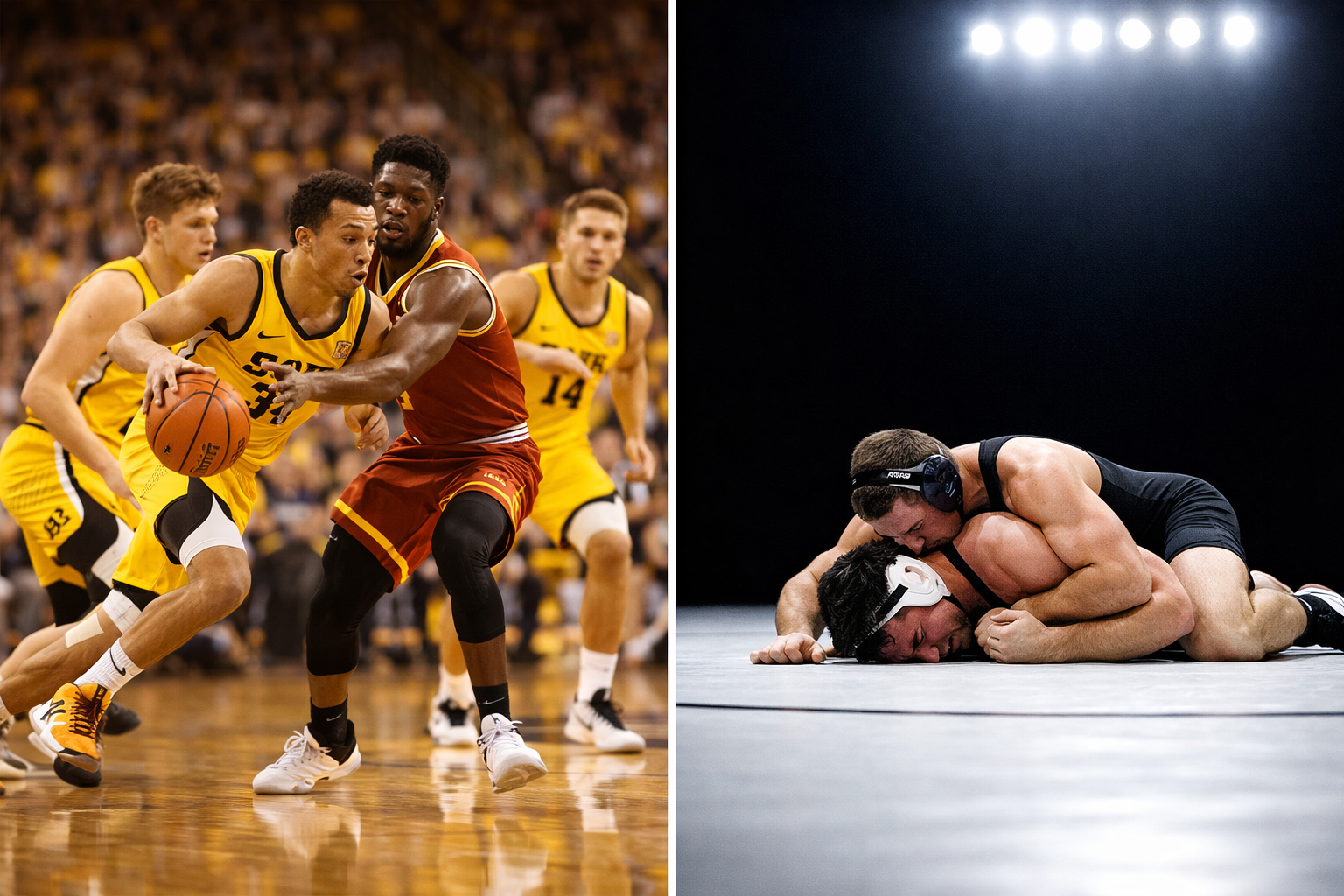
One of those weekends landed in March, when the NCAA basketball tournament and the NCAA wrestling championships happened to overlap. On one screen, 68 teams were busy wrecking brackets, turning reasonable adults into shouting strangers over a missed rotation. In Cleveland, the wrestling championships offered something older and less forgiving: one mat, one opponent, one clock, no illusions about who was about to have the better night.
Basketball and wrestling aren't just different sports. They're different philosophies wearing athletic tape. One tests whether a group of people can think and adjust together under pressure. The other strips the group away entirely and leaves you with an opponent, a clock, and whatever you actually prepared for. Watching both in the same stretch of days got me thinking about something bigger than the scoreboard — what kind of competitor are you, and where did that get built?
The Machine and the Mirror
Team sports and individual sports both build discipline and resilience, but they don't build the same kind of person. Team sports teach how to operate inside a system. Individual sports teach what happens when the system disappears and it's just you.
I grew up playing soccer, maybe the purest team sport there is — eleven people moving together, each depending on the others, the ball invisible to whoever's two feet away until it's too late. In the spring I played tennis, a lonelier business entirely: no huddle, no bench to reset your head, no teammate to bail you out after a double-fault turns into a small personal weather event late in the third set.
Tennis was the perfect test case, because I played both singles and doubles that season. Same court, same racket, completely different psychological experience. In doubles, a bad point belongs to both players, which dulls the sting. In singles, every hesitation and every unforced error belongs entirely to you.
I also wrestled for exactly one year — long enough to build permanent respect for wrestlers, and equally permanent gratitude that I didn't stick with it. These days my individual-sport résumé has aged into racquetball, pickleball, and golf, and the accountability hasn't softened one bit. If I lose at racquetball, it's not because the offense stalled or the rotation broke down. It's because I hit three balls into the tin and made decisions no lawyer, however generous, could defend.
That's the real divide between team and individual sports. In one, responsibility gets shared around the room. In the other, it doesn't have anywhere else to go.
What Team Sports Know About Real Life
A kid in a team sport learns fast that success is rarely his alone. You can play well and still lose. You can do your job exactly right and watch a teammate dribble into a crowd like he's been personally summoned there. That's frustrating, but it forces young people to live with imperfection and shared effort long before adulthood makes them do it for real.
Families are team sports. Workplaces are team sports. Leadership is a team sport. Almost nobody gets to build a life entirely around their own pace and preferences — most of us spend our days cooperating with other humans, which is noble and necessary and, some days, feels a lot like herding geese through a thunderstorm. Anyone who's watched a talented team come apart in the final two minutes has seen the real lesson: talent gets you into the game, but trust decides whether you survive the ending. Researchers call this collective efficacy — a group's shared belief that it can execute together under pressure — and it consistently predicts outcomes better than raw talent alone.
What Individual Sports Refuse to Soften
Individual sports teach something else, without much padding. Lose in one and the room goes quiet fast. There's no scheme to hide behind, no teammate's blown assignment to point to, no comforting story about how the outcome was really a group effort. The scoreboard just sits there, an honest little witness looking directly at you. That can be brutal for a young athlete. It can also be one of the most valuable things that ever happens to them.
Wrestling, tennis, swimming, golf, racquetball — they build a specific kind of internal accountability: prepare when nobody's coming to rescue you, absorb a result you don't like without shopping around for someone to blame. Wrestling might be the cleanest version. Two people, same mat, same clock. Nothing gets negotiated by committee. Basketball asks whether five people can solve a problem together. Wrestling just asks whether you can.
Not all individual sports apply pressure the same way, either. In golf, gymnastics, and swimming, you're competing against a standard — you post a score or a time and wait to see where you land. The pressure is real but a little abstract. In tennis, wrestling, and racquetball, you're beating one specific person across from you who would very much prefer you didn't. There's no hiding behind a number. I enjoy golf, and there's real satisfaction in a good round, but beating someone at racquetball who's taken the last three matches off me hits differently — it was personal in the honest sense. I had to take it from someone just as determined to take it from me.
That split shows up in coaching too. A team coach is part tactician, part psychologist, juggling personalities and egos and the athlete who looks unstoppable in practice, then performs on game night like his shoelaces have filed a complaint. An individual sport coach matters just as much, but the evaluation is cleaner — who won, who performed. The trap here is different: without steady coaching, "I lost the match" can quietly become "I am the loss." The goal was never to raise a kid immune to disappointment. It's to raise one who can compete, absorb a result, and come back for the next one.
The Best Competitors Learn Both Languages
Team sports teach loyalty and the discipline of functioning inside a group without letting your mood become the weather everyone else has to live in — useful in nearly every adult relationship you'll ever have. Individual sports teach composure and the willingness to own a result without excuses. Ideally, a kid gets a real dose of both before life starts keeping score in ways that matter more than a bracket.
Tennis taught me both in a single season — how to depend on the person next to me, and how to stand there completely alone. Same court, same racket, two entirely different educations. Most of the lessons worth keeping work that way. They show up early, wait around patiently, and only explain themselves years later.
That March weekend felt less like entertainment and more like a mirror. Basketball gave us chemistry and collective belief, five people solving a fast-moving problem together with a season on the line. Wrestling gave us something older and simpler — one person, one opponent, one outcome, and very little room to spin a story afterward. Some days the job is to be a great teammate. Other days, nobody else can take the shot, make the call, or own the outcome for you — and the sooner a person learns which day is which, the better they handle both.

Thanks for reading!
Subscribe to receive my weekly newsletter, alerts when new posts are available, and occasional updates from me.
Thank you for subscribing!
Have a great day!