Don’t Sleep on Direct Mail
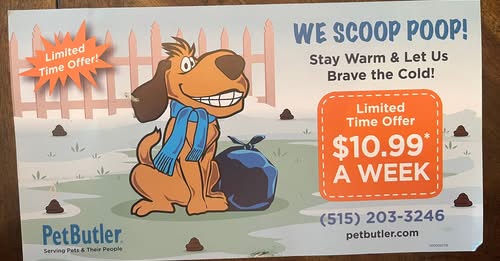
Saturday morning, kitchen table, the adult tax of living due in full. Bills. More bills. A credit card offer addressed to “Current Resident,” as though I’m some nameless woodland creature squatting on the property. A Golf Digest I will absolutely read cover to cover the moment I find forty-five uninterrupted minutes, which is to say never. And something from AARP, which I’m going to mention exactly once, without further comment, because I’m still working through what it means that I qualify.
And then a postcard. Not a regular one, either. A jumbo postcard, the kind built specifically not to get lost in the shuffle or fold itself into the recycling pile by accident. It was from a company called Pet Butler, pitching pooper scooper service, dog walking, and pet shuttle runs. A business built on a completely reasonable insight: people love their pets and would still rather not deal with everything a pet requires.
I smiled. Not because the services were groundbreaking. They weren’t. But the format stopped me and the copy held me, and then I hit the price: $10.99 a week per pet. Without meaning to, I started doing the math. That’s the whole trick, and it worked on me even though I’ve spent a good chunk of my career studying marketing and know most of the moves in this particular playbook. In a world of overflowing inboxes and ads we’ve trained ourselves to scroll past without registering, a piece of cardstock had just done exactly what it was designed to do. It made me stop, made me read, made me calculate. Direct mail still works, and don’t let anyone tell you otherwise.
A $25,000 Bet in a Bad Year
I know this because roughly seventeen years ago, I put real money behind the same idea.
I’d just opened Brown Veterinary Service in 2007, a mixed animal practice with a small animal hospital and a busy ambulatory side. The large animal work more or less ran itself. Cows don’t require a multi-touch nurture campaign. They require a truck, a thermometer, and somebody willing to climb through a gate that should have been replaced during the Clinton administration. But quietly, we were also offering small animal house calls and at-home euthanasia. The clients who found us loved it. The feedback was strong, the need was clearly there. The problem wasn’t the service. It was that almost nobody knew we offered it.
Around that time I came across an ad for PostcardMania, a company built entirely around direct mail campaigns. The pitch was straightforward: targeted lists, a clear offer, measurable results, backed by a website full of case studies showing strong returns. Were those numbers a little generous? Almost certainly. Nobody publishes the marketing equivalent of “this was a financial woodchipper, but we learned a lot.” Even discounting for the optimism baked into anyone’s own case studies, the underlying logic held up. If the right message reached the right household at the right time, this wasn’t going to be a nostalgia play. It was going to be a business tool.
So I built a campaign around one offer: the first house call visit, no trip fee. Clients still paid for the exam and whatever care their pet needed, but the friction of that first call disappeared. We targeted pet-owning households within a specific income range, inside roughly a twenty-five-mile radius of the practice. This was not spray and pray, but narrow enough to actually matter. A good offer doesn’t need to be clever. It just needs to make the first yes easier.
The timing, in hindsight, was almost comically bad. It was 2008, and the economy was unraveling in real time on the evening news. Brown Veterinary Service had been open barely a year, still absorbing the cost of new equipment, new hires, and a new building. Twenty-five thousand dollars was not a rounding error, and it wasn’t “let’s see what happens” money either. It was the kind of number that makes you pause before signing the check. But I’d looked at the margins, believed in the offer, and made the call anyway. It wasn’t a gamble. It was a calculated risk, and those two things are easy to confuse until you’re the one holding the pen.
Within weeks of the postcards landing in mailboxes, the house call side of the practice took off. The phone rang. Clients called who’d never called before. Demand that had been sitting out there untapped suddenly had a reason to act, and the campaign paid for itself and then kept paying. The postcard was the invitation. Everything that mattered after that, including the trust, the care, and the actual relationship, was what built the business.
Why the Analog Lane Still Delivers
It’s tempting to assume anything analog has been quietly retired by digital efficiency, and on paper, that assumption makes sense. Digital marketing is faster, cheaper to test, and easier to measure in real time. But effectiveness was never about convenience. It’s about what actually moves someone to act, and a printed piece of mail still has a few structural advantages that digital simply can’t replicate.
It doesn’t vanish the second you close a browser tab. It doesn’t get auto-filtered into a promotions folder nobody opens. It occupies physical space in a home, which means it lingers. It can sit on a kitchen counter for three days, get picked up twice, get handed across the table to a spouse who wasn’t part of the original conversation, or live under a refrigerator magnet until somebody finally says, “Didn’t we get something about that?” That is not nostalgia. There’s a reasonably well-established idea in marketing and cognitive research that physical materials get processed and recalled differently than digital ones, largely because handling something tangible takes more effort and attention than a thumb-swipe past a feed.
Direct mail also carries a kind of credibility that unsolicited digital ads have lost. We have spent two decades training ourselves to distrust banner ads and skip pre-rolls, but most of us still open the mailbox without that same reflexive suspicion.
There’s also a quieter dynamic at work: as more businesses pile into digital channels, competition for attention there gets more expensive and more crowded by the week, while fewer companies bother with direct mail at all. That imbalance is exactly why the channel still performs. When your competitors abandon a lane because it isn’t trendy, that lane gets cheaper to stand out in and far more likely to actually get noticed. Sometimes the opportunity isn’t in doing something new. It’s in doing something effective that everyone else decided wasn’t worth their time.
None of this is an argument for flinging money at postcards and hoping for the best. A cluttered mailer with no clear point is just recycling with postage, and bad direct mail is exactly as useless as a bad digital ad, maybe worse given what it costs to print and send. The Pet Butler card worked on me for the same reasons my own 2008 campaign worked: a clean format, tight copy, and an offer specific enough that a reader could do the math in their head without needing a calculator. A vague offer will lose to a mediocre digital ad every single time. A sharp one, sent to the right list, still moves people to act in a way plenty of flashier, more modern tactics simply don’t. The metric that matters here isn’t impressions or clicks. It’s response, and that distinction gets lost more often than it should.
The Invitation and the Payoff
I’ve now seen this play out from both sides of the counter: once in 2008, as the business owner writing a check he genuinely couldn’t afford not to write, and once last Saturday, as the customer doing mental math on a pooper scooper service he probably will never use.
What connects those two moments isn’t the product or the price point. It’s clarity. Pet Butler didn’t try to impress me with complexity or bury the value in explanation. They handed me a service, attached a number to it, and let me do the rest of the thinking myself. That’s what good marketing actually does. It doesn’t need to persuade so much as it needs to remove the friction between noticing something and understanding it.
The postcard itself was never the whole strategy. It was the invitation, the moment a stranger decides you’re worth a second look. Everything that happens after that, including the relationship, the follow-through, and the value actually delivered, is where a business gets built or doesn’t. But nobody gets to that second part without someone opening the door first, and it turns out a well-made piece of cardstock, seventeen years apart and on opposite sides of a very different transaction, is still remarkably good at knocking.
Pet Butler, wherever you are, well played.
Thanks for reading!
Subscribe to receive my weekly newsletter, alerts when new posts are available, and occasional updates from me.
Thank you for subscribing!
Have a great day!